Since Halloween is just around the corner, I figured I'd continue what I started in the previous blog. Last time we took a look at the horror classic, Night of the Living Dead. This time, we can take a gander at its sequel, Dawn of the Dead. So, away we go...
It wasn't long after I saw NotLD for the first time in my sophomore year at college that I naturally sought out George Romero's sequel, Dawn of the Dead. I got it on VHS- a 2 tape set. (Sadly, I got rid of it when I got the deluxe DVD version- wish I hadn't). And, if I thought NotLD was a masterpiece, well, let's just say I was just floored by DotD, and then some.
First, some disclaimers, once again. Like last time, you have to accept a few things going in if you're going to enjoy the movie. Once again, this is an independent film (one of the most successful of all time as a matter of fact). As a result, there are still some wonkiness to it, though nothing like NotLD. Further, Romero gives himself some free reign to put in a little bit of weirdness- some odd dialogue choices and such. To me, they only add to the "Our world has gone to hell" idea. Finally, the special effects- they were revolutionary for their time, but as compared to more modern fare they are lacking. Again- consider the time and how this was pioneering work. Last, you should know there are multiple versions/cuts of the film- the extended cut is the best one, and my review is based on that.
The same rules also apply- you should watch it alone or with a significant other (though this does work better than NotLD in having a fun group to watch it with- but still). It should be watched late at night and in the dark. Again- you want all the atmosphere that you can get. You won't regret it.
Spoilers below, FYI
So with that, let us now turn to my review:
Building on NotLD:
The first thing to recognize about Dawn is how it increases the stakes and the scale. This movie takes the ideas presented in Night and just expands upon them enormously, taking them to their logical conclusion. The zombie menace continues to grow. No one is safe, and the fight against them is taking its toll on both individuals and society. Things are starting to fall apart, as the zombies just keep coming. The movie shows this to great effect several times. The cops and National Guard raid a project in Philadelphia and chaos ensues. You don't see the rest of the city, but you just know this is what is going on everywhere. Many of the cops and lawmen are scared and can see they are fighting a losing battle. One goes crazy, shooting at everyone (zombie or not). Another commits suicide rather than face the hell that the world has become.

We are witnessing a world in it's death throes. Via what our 4 main characters see and what we see on the television, little by little we see the zombies taking over. When our heroes fly out of Philly, one of the bigger building has its lights still on, but they start going out quickly floor by floor- ominous. Once at the mall, where our 4 believe they are safe- we just see more and more zombies appearing. By the end, no one is airing anything on the TV, and there are more (ever more) zombies outside. It is very clear that there is almost nothing left. It truly is the Dawn of a dead world. The scale of this film is nothing short of epic.

The plot is once again straightforward, but is deceptive in its simplicity. Steven and Fran are a couple (not married but together) who work for a TV news station. They are seeing firsthand that the world is vanishing right before their eyes. Steven decides that they are going to "run". They plan to steal a traffic report helicopter and escape- to anywhere. But Steve knows that this is dangerous, and could use some help/protection. His friend Roger is just such a person. Roger is in the National Guard, equipped with a rifle and trained. Roger isn't sure he wants to "run", but after the horrors he sees in the projects, he decides to bolt. Before he does, he meets another guardsman, Peter. He offers Peter the chance to leave with him. The four then take off on the helicopter. It seems everyone is either dead or running out now.
Along the way, our heroes see the end of the world going down in flames, and they get into some tough spots, etc. Finally, just as their fuel is running low, they spot a shopping mall. They could stop, resupply if possible, rest, etc. But once in the mall, the group begins to think- what if they could stay? The mall has everything that they could ever need after all. If the world is a ruin, at least they can live out their last days in comfort and relative abundance. They just have to secure the mall from the zombies- a task easier said than done, naturally. What follows is a struggle to survive in the worst horror imaginable- a world of the dead, with no hope at all.
History:
Like Night, Dawn is very much a reflection of its times. If Night was a mirror showing how anxious Americans were afraid of the social changes of the 1960s, then Dawn does the same for the 1970s- showing America's growing cynicism, selfishness and detachment from the world's problems.
Let us start with the rather cynical attitude that was forming in the American consciousness in the 1970s. The decade starts off with a continuation of the problems of the sixties, though some of these problems have receded (not solved, just no longer at the forefront). However, any chance that America might find some social peace falls apart with the Watergate scandal. Watergate, a word now synonymous with government corruption, rocked the United States to its core. President Nixon, who was elected by saying he would restore law and order, was basically caught doing many illegal things, and using his power to cover them up. The scandal lasted for over a year, till Nixon finally resigned. But the damage was done. Americans now believed the very worst of their elected leaders. To make matters worse, we seemed to be losing the Cold War. The Soviet Union was resurgent, and the Middle East was spiraling out of control. Oh- and of course the United States lost Vietnam ("When the dead walk... we must stop the killing, or we lose the war" is obviously a reference). It seemed we were powerless, and our leaders had failed us utterly. As a result, Americans treated their government with a cynical attitude (and, to varying degrees, have ever since).

America has long been known as the land of opportunity and the land of plenty. America generally had anything and everything a person could want or need- and in almost wasteful abundance. 2 cars in every garage? A suburban house with a pool? A color TV? Video computer games? You name it- Americans had it. Since the end of World War II, Americans were far more prosperous than just about any nation on earth. America's got it all. But by the 1970s, this was starting to change. The economy was starting to go downhill. It was known as stagflation- wages were stagnant but prices were inflating rapidly. People had no choice but to buy LESS because everything was going up. Further, gasoline became a major problem as on a few occasions in the 70s, the Middle East reduced oil production (the Oil Shocks). This hurt America even further. Americans wanted consumer goods, even as they couldn't afford them as they had in the past. This made Americans anxious and even selfish. Each American would scramble to "get theirs", and to hell with everyone else.

As these economic and political problems mounted, social issues remained unsolved as well. African-Americans, though they accomplished much in the previous 2 decades, found their Civil Rights movement was slowing down, and blacks now faced "softer" forms of discrimination. The feminist movement also challenged society, though the fight over abortion added new dimensions to this, tearing the women's movement apart. Americans, who seemingly had been through enough in the 1960s, had no stomach for all of this. America ignored these and other problems, essentially sweeping them under the rug. This was the era of Disco and Drugs- cynicism and selfishness combined- causing Americans to lose touch with these issues, and perhaps, their true selves.
As we shall see, Dawn does just what Night did a decade earlier. It serves as a nasty reflection of the 1970s. Our heroes act in selfish ways, and they are laced with cynicism. They believe (rightly) that no one can help them- government has failed, so they have to just take care of themselves. It is their (understandable) desire for goods and comfort that cause them to try to stay at the mall, despite the risks. It is their growing detachment that make them abandon the world to its fate. These 4 characters are Americans in the 1970s. We understand why they feel this way, even if we can't quite agree with/believe in what they are doing.
And the zombies? well, they are consumers too after a fashion, aren't they? With that in mind, let us turn to the zombies themselves...
The World Is Ending- and Its Bleakly Funny:
Indeed, once the characters get to the mall, the joke (and it is a bitter joke) is that the people taking refuge in the mall are just like the zombies- they are consumers, drawn to the mall. At several points, Peter, Steven, and Fran make it abundantly clear that the zombies are us. They still have some semblance of memory- and they remember shopping. As Steven says coldly "This was an important
place in their lives".
The joke continues- as the zombies aimlessly walk around the mall, the connection couldn't be any more obvious. They walk around, looking at the merchandise, gently moaning or sighing as they move on to the next display counter. Even as humans run past them, many zombies continue to gaze about the mall, looking for that perfect thing to buy. The zombies are us- mindless consumers looking for the next purchase, with no thought for the morrow (or anything else, for that matter). This is clearly a satire. While Night wanted to scare with its apocalyptic scenario and tough moral choices, Dawn wants to scare, but it is also mocking us. The movie itself never becomes a joke (though one scene almost breaks the 4th wall), but it is poking fun at us nonetheless. The scares and thrills are still present, but there is satire as well, and Romero makes it clear for all to see. We are consumerist zombies, dead to anything else but the desire to "consume".

The main characters desire what is in the mall, but the pace is crawling with zombies (hostile shoppers?). Our heroes will have to kill ALL the zombies AND seal the doors in order to secure the mall for themselves. With almost clockwork precision, they go "on a hunt", shooting all of the undead and blocking the doors. As the hunt ends, the music becomes dramatic as our heroes look over the mall- the place is littered with the bodies of the re-killed zombies. It is a grim moment. You actually begin to feel bad for the zombies, in a twisted way. And our heroes actions- driven to such destruction for material comfort- is rather unsettling for us. But would we be any different?

But the joke isn't yet finished, for now we must consider the climactic final battle. And it isn't against the zombies exactly. Despite the fact that the world is quite dead, there are some scattered survivors. A new group descends upon the mall. They are "raiders"- bikers- some may be criminals, others ex-army. Whatever they are, they blow their way into the mall like marauders, plundering and destroying. The zombies follow them in, leading to a brutal 3 way contest between our heroes, the raiders, and the zombies. The bikers act with a reckless abandon and brutality (and half crazed, judging by their actions), and they are better armed and better coordinated than our heroes. Within moments, the mall is a deathtrap for all involved, human and zombie alike. Though you love our heroes, you can't help but see what they did to the zombies is now what the bikers are doing to them. The bikers steal what they want and then run out (they apparently survive on the road). All the work our heroes had done to secure the mall now lies in shambles, and it can't be fixed. The zombies are in the mall once more, and our remaining heroes are screwed. It comes full circle now, both the plot and the satire. The humans are clearly WORSE than the zombies.

The movie certainly works as a satire of American consumerism and selfishness. The entire tone of the movie is filled with it; there is more humor here than Night (which is totally devoid of humor), but it is a black, gallows humor at best. The scene that almost goes too far is when the bikers take pies from a mall bakery and start to throw them at the zombies. The satire has now become absurdest comedy. However, before this zombie pie fight threatens to derail the movie into silliness, Romero wisely goes back to the horror of the situation, with graphic carnage on display at throughout the battle. However, the pie fight remains a wink and a nudge to the audience as to the true message of this film- our mindless consumerism is a cruel joke with no real point.

The tone of the movie is satirical, and in a way the actual filming itself was as well. Romero went all out here, with tons of neon bright blood spraying everywhere, big action scenes, etc. Again, there is more at play here. The movie is itself making a comment on "America: Our stuff is bigger and better"- thrilling action, buckets of blood, tons of zombies- everything is more more more. The movie takes on an almost comic-book quality with splashy scenes of stylized violence and incredible feats; Our heroes almost effortlessly cleave through the zombies in their initial purging of the mall, it could very well be an American action movie blockbuster. Again, this "super-size" approach makes not just for a great movie, but it also serves the satire of consumerism to a tee.
They'll Tune Out!!
Also serving for satirical purposes is Romero's strategic use of television. In Night, Romero understood that Americans looked to TV as a comfort. Even as America was becoming unglued in the 1960s, Americans could tune into Walter Cronkite to reassure them, or tune into their favorite program to help them relax or forget their problems. Night used that to terrific effect, our characters watching the TV and taking comfort in the newsman's words.
Romero pulls yet another rabbit out of his hat for television's role in Dawn. By the late 1970s, Americans grew cynical about lots of things. As it turns out, TV played a huge role in that. As the news continued to push the issues of Watergate, losing Vietnam, and more- Americans became ever more jaded and bitter. By this point, Americans had had enough of the news. They turned away from it as much as they could. What's the news? Who cares- its all bad.

In our first scene, we meet Fran in the news studio of where she works. The place is chaotic, to say the least. The newscaster is talking to a government official about the zombie emergency. As the official makes his statement, TV crew members begin to yell and boo him- right on the air. Even the newscaster yells, saying that people don't believe the government ("... and I for one don't blame them" he shouts). More booing ensues. The guy can barely get a word in edgewise. It is clear from scene one that the people have lost all faith in the government. The booing studio workers certainly have Watergate on their minds. And remember- there is a crisis her of epidemic proportions- and they won't listen to the government.

But Americans have also lost faith in the media itself. Fran finds out that the "crawl" on the screen, showing "rescue stations", has out of date information. Most of those "rescue stations" have been overrun. Fran decides to stop the crawl- she doesn't want to send people to rescue stations that don't exist, as that would be sending them out to die. Her boss however, yells at her, trying to get her to put the crawl back on. Fran refuses. The boss says without the "rescue station" info the people will "tune out". Yes, he doesn't care that the info is inaccurate and could cause deaths. He only wants viewers. Right here, you lose faith in the news as well, reflecting American sentiment of the mid 1970s.

There is more though. The next time we see a broadcast, our heroes are watching TV in the mall- the news broadcasts have been getting further and further apart (unsettling in its own right). The person speaking is yet another government expert. He has an eye patch on (of all things), and he stands at a podium (where we don't exactly know) with the sound of flashbulbs and reporters grumbling. He yells at them, complaining about the reporters' criticism of him and the government. This is not comforting, to say the least.
The broadcasts become more infrequent. The next (and last) broadcast we see is the same expert talking to yet another news host. The background is a mess- a ladder, ratty curtains- its not so much a studio as it is a shambles. When the anchor asks what can be done, the expert says that the only solution may be to "feed them". Yes- this is the best solution our government has to offer apparently. The newsman criticizes this, but offers no other solution either. The expert, exasperated, asks rhetorically if humanity is "worth saving". Media and the government are both worthless now.
Toward the end of the film (before the bikers come in), Steven turns on the TV, explaining that he hoped that the news would be on again soon. There is only static on the TV. Fran says there's been nothing for a while. Steve refuses to listen, waiting for more news. Fran gets frustrated and turns the TV off. Steven, now angry at Fran, turns it back on. But the news never comes back. It must truly be the end of the world if there is no chatter on the boob tube. In Romero's hands, this is both terrifying and hilarious.
Characters and Fate
Whereas the characters of Night were closely aligned with the social challenges sweeping the nation in the 1960s, our main characters in Dawn are broader archetypes. Make no mistake, these is some reflection of the social issues, but it is more muted in favor of the satire of commercialism. Nevertheless, the foursome are just as compelling as those of Night.

Let's start with Roger. He is a National Guardsman who seems to have a bit of experience (he's no rookie). At the start of his first scene, he is about to breach the project that contains zombies with other Guardsmen. He talks to a fresh-faced partner, telling him to be calm. He seems to be a voice of reason. However, as he fights through the tenement he has several encounters (both with zombies and a Guardsman that has gone "apeshit") that nearly kill him. Yet with cleaver thinking he manages to survive. As the plot progresses, Roger has more such close calls, and each time he finds a way to walk away unscathed. But the reality of the situation IS starting to wear on him- he becomes ever more reckless, thinking that he can't lose. In a way, he represents the "can do" spirit of America. Despite any trouble, America will prevail. Roger takes even more risks, and even laughs it off.
However, like 1970s America, Roger's luck seems to run out. He gets bitten twice after making several mistakes. He is now doomed to become a zombie at some point. However, he lingers, seemingly regressing to a more childlike state (shock? denial?). His end is a bitter one. He lays on his sleeping bag, being given injections for the pain. He is talking to Peter about how great they did clearing the mall ("We whooped 'em, didn't we?"). He then exclaims "We whooped 'em and now we've got it all"... he says as he lays in his own filth and sweat, 2 minutes from becoming a zombie. The camera angle and lack of music says it all- he is pathetic. When he does turn, Peter shoots him. So much for having it all.

Peter is the other runaway National Guardsman. He is a large and physically imposing African-American. However, he is nothing like Ben in Night. Peter seems mysterious- and a little dangerous. Again, let us consider the time. At this point, the Civil Rights movement has dissipated, but there are still racial concerns. One of them is a new "trend" in Hollywood- the so-called "Blaxploitation" films. Hollywood thought it could capitalize on black audiences by making films supposedly aimed at them. These movies featured black heroes but were filled with all the stereotypes you could imagine- including "street" slang and "bad-ass" attitudes. The films were mostly silly though some found them offensive. However, this is the "black man" that exists in Hollywood. We are now in a strange place, and quite far removed from the quiet and thoughtful Ben.

However, while this image may "inform" Romero, but he never gives into it. He has Peter act like a tough man, with a threatening masculinity (more on that in a bit). He feels a deep connection to the people of the project. He refers to the people as "brothers". Fran even asks him if he means "real" or "street" brothers (to which he replies "both". However, Peter remorsefully acknowledges that he is leaving them behind). He uses some street slang ("sucka" and "bread" spring to mind). He has some knowledge of Voodoo (which is where the film's tagline "When there's no more room in hell, the dead will walk the earth" comes from). He hints that he knows how to preform an abortion (again, being from the rough streets with drugs and back-alley abortions). He could well be a "Blaxploitation" hero. He is fast and strong. However, his performance is very subdued, and he conveys much with a look, rather than bombast typical of blaxploitation character.
Romero also makes sure that Peter isn't just a black action hero. He gives him a lot of gray areas ("We're thieves and bad guys..."). Peter is the one who convinces the others to try to stay in the mall. Later, he clearly feels bad for his friend Roger. And then, at the very end, Peter considers suicide, rather than leave the mall (more on that in a bit).
Peter is a conundrum for our other characters, Steven and Fran. These two are a couple, though not married. The arrival of Peter is met with a bit of fear and frustration by Steven. On the helicopter, Peter sits next to Fran, and "suggestively" asks her if Steven is "her man". Steven is threatened by this strong black man- could he take Fran from him? Steven is a rather wimpy guy too- he can't shoot worth a damn. Roger and Peter show him up several times in front of Fran- though it is Peter who threatens to shoot Steven if he messes up again. Fran begs him not to, and Peter relents. Steven has been emasculated.
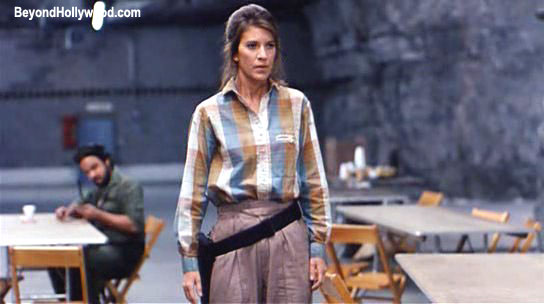
Steven does end up contributing, even acting like "one of the boys" as it were, though he is never as good as Peter. Meanwhile, Fran is pregnant and vulnerable. However, she doesn't want to be- she insists on being given a gun (and is actually a better shot than Steven). She also insists later in the film that she wants to know how to fly the helicopter, just in case.
However, there is clearly tension in her relationship with Steven. He seems not to value her opinion, though Peter clearly does. Does Steven love her, or is he feeling trapped- due to the baby and the zombies? It is never clear. Toward the end, as the three (Roger is dead) settle down for life in the mall, Steven presents 2 rings to her. Fran declines, saying "it wouldn't be real". Fran has been the only person in the group to be against staying in the mall. After all, they are in the mall trying to forget everything, as if this were normal. She cannot accept that, crying out "What have we done to
ourselves"?
So- what is their ultimate fate? During the biker attack, Steven gets cornered by the raiders and is shot (though not killed). Trapped in the elevator, Steven is in pain. The doors open, and he is attacked by the hungry zombies. Peter hears it on the radio, and realizes there is nothing he can do. But, he hears Steven's gun. Is he alive or not? Peter goes back to Fran, and they wait.

Hours pass. And when the elevator doors open, Steven, now a zombie, is standing there- bloody and gruesome. As he wanders the mall, he "remembers" where they hid before, and he moves in that direction, with the other zombies moving with him. I love this bit- yes, it is zombie hunger. But- what if? What if he still has some memory. Does he think that Peter can now move in on Fran? Will Peter and Fran be the ones to live happily ever after- and NOT him? I like to think that IS what is happening- all the resentment and emasculation driving him to destroy them. Now, I know, he's just a zombie. But surely it is a tantalizing idea.

Steven enters where Peter and Fran are hiding. Peter shoots him once through the head. There is no time to mourn, as more zombies are coming. Fran is ready to leave, but Peter tells her to go on without him. He says he just can't go on anymore ("I don't want to. I really don't"). As Fran goes to the helicopter, Peter puts a gun to his head. A zombie breaks through- a young black zombie. Suddenly, Peter's eyes change- he refuses to die after all. He fights his way past the zombies, making it to the helicopter. The two fly off- though where can they go?

Peter's escape is slightly unbelievable, complete with "action" music one would find in the A-Team or something- full of bombast and heroism. How could Romero allow this- he who killed EVERYONE in Night? How could he let a sad suicide become a successful lunge at life? Is it that Romero is sentimental? Perhaps. Or maybe he just didn't want another nihilistic ending? However, it DOES go along with the satarization of America- we demand the happy ending in our entertainment. We expect it. So, Romero plays along (just as he has throughout)- Peter and Fran do escape. Yay!

But as the helicopter flies off, the scene gives way to the big clock in the mall. There are cobwebs on it- how long has it been? We never know. Instead, the viewer is treated to the sights and sounds of the zombies wandering the mall. They are everywhere. The credits play over the footage, as does the rather incredible "The Gonk" music (Mall Muzak as it were). As the credits end, the clock tolls. There is no life. No coda showing our heroes. Only zombies. They are truly everywhere. And where can our heroes go? While thrilling, Peter and Fran's escape is only temporary. Where can they go?
Conclusion:
Like the Godfather Part II and Empire Strikes Back, Dawn of the Dead expands upon everything presented in Night with incredible skill. The action is on a much larger scale, and the stakes couldn't be higher (for our heroes and the world). The nihilistic tone remains, but there is also a very effective satire, a one upping of Night in terms of complexity and meaning.
Dawn is a masterpiece of the horror genre. It is also THE zombie movie extraordinaire. Every zombie work made since (print, TV, or film) have been inspired by Dawn- this is the gold standard. This is the one they all aspire to be.
Until next time...